Tuesday, March 18, 2014

Media Convergence - Music File Sharing


Mix Tapes/Cassette Tapes
Maybe one of the earliest forms of file sharing were cassette tapes, mixtapes as they are affectionately called by some. It has been said that personal mixtapes were, ""the most widely practiced American art form."

Previous to the use of cassette tapes, making personal pop mixes was difficult for the causal music listener, with no access to equipment capable of doing so. However, when cassette tapes and music recorders became more popular, requirements for getting music recordings were reduced to only blank cassette tapes and a recording device connected to a source of prerecorded music such as the radio.


Boombox
The first "Radiorecorder" was released in 1969 by Philips of the Netherlands, and was the first time that a radio broadcast could be recorded without the use of cables or microphones.

CDs
The jump to the digital age opened up a whole new ballgame and the advent of the recordable compact disk marked a new era of file sharing. Music was no longer confined to a single piece of hardware, but also existed digitally, meaning those files could now be shared and distributed.

Personal mixes became easier than ever because, not only could songs be downloaded to a PC and then burnt to a writable CD, but songs could also be uploaded to the internet and other types of software for distribution and pirating.

For a brief period of time, several record companies attempted to create CDs with copy protection. However, these CDs were not compatible with certain audio players and were eventually seen as violations to fair use copyright law.


This jump eventually set into motion a chain events that led to music situation we live in today. First, according to some sources, it hurt the growth of CD sales. It caused loss of sales in music retail stores. Most notable is, some sources have stated that between 2004 and 2009 a total of $30 billion worth of songs were downloaded illegally (original article).

Brief History of Digital File Sharing
1970s - Floppy disk became the first instance of removable media.  Removable media becomes target of media efforts against sharing of intellectual property.
1980s - File sharing done by modem over landline telephone.
1990s - Basic ideas for filesharing established.  File compression technology improves, but is only available to general public toward the end of the decade. MP3.com is created.  Napster is created, which utilizes centralized structure for servers.
2000s - Gnutella is created as a decentralized sharing network.  Napster is shut down.  Various other file sharing services are launched such as Morpheus and Kazaa, and are subsequently modified or shut down.  Legal file sharing service, "iTunes" is launched.
2010s - BitTorrent protocol and clients become more stable.  Pirate Bay trial verdict was announced.  Megaupload shut down and internet hacktivist group Anonymous responds by attacking various organizations.

How does it work?
P2P - Users connect to a peer-to-peer network to search for shared files on the computers of other users connected to the network.  Larger files are usually broken up into smaller chunks obtained from multiple peers, which are then reassembled by the downloader.
Examples: Napster, Morpheus, BitTorrent

File Sync and Sharing Services - Special folders are created on each of the computers or mobile devices, and then are synchronized.  Files placed in these folders are viewable on both, or multiple computers.
Examples: Dropbox or Google Drive
(source)

A Case for File Sharing
Practicality:

  • There are usually only a few songs on an album you like anyway
  • It can be used as a publicity tool for bands
  • Music listeners and artists stop thinking about music in terms of buyer/seller relationships
  • Artistic integrity might not be at the top of producer's priority list
  • Many songs would not have been bought even if P2P programs didn't exist at all
  • One study suggests that there is no direct relationship between P2P file-sharing and CD purchases (in Canada). (source)


Legality:

  • It's legal if artist allow their work to be shared -

"We encourage and promote the free exchange of our own music on the Internet using file sharing programs and P2P networks.  We consider this new opportunity to share our music and ideas with others, and for others to share our music and ideas with each other, to be good for us, good for society and, good for art." (Statement from band Negativland)
"But in the midst of the firestorm, countless other bands have been quietly benefiting from the increased exposure that P2P programs provided, and despite legal setbacks, filesharing has inevitably fallen into its natural role as the next big publicity tool." (original article)

To Be Continued 

Monday, March 3, 2014

New Device: Glass

When first watching the video “A Day Made of Glass” I was pretty blown away. This is the kind of stuff that we only see in the movies. I feel like I saw of some this similar technology in scenes from Iron Man and The Jetsons. Seriously, it’s the kind of technology that science fictions writers could only dream about. 

A Day Made of Glass 1

A Day Made of Glass 2

Now, this isn’t necessarily a device in and of itself, but almost a new way of viewing living.  It is a concept that is pretty revolutionary concept. Imagine a house, a store, an organization that has access to this technology. How would things be completely changed? How would it change advertising, medicine, and even movie nights with the family? Well, in a lot of ways perhaps. It would change the way that people would interact with the world and their surroundings.

Imagine connectivity on your mobile device and in your surroundings. Imagine further the integration of your device with your surroundings. Almost every surface becomes a possible screen, a possible way to gather information. Even in nature, the transparent nature of this glass opens up many possibilities and the ability to superimpose other images onto surroundings creating an immersive experience wherever you are.

Convergence
In responding to consumer values, this technology creates access points in almost every setting, home, work, stores, even in intimate places such as a bathroom. It is very useful in that information and connection can be achieved wherever you look. One thing that did occur to me, however, was that people who have lost the ability to see would be very disadvantaged if the world was “made of glass.”

Consumerism
In regards to consumerism, since the product is glass, it is very adaptable and can become whatever a user would desire it to be as far as color and appearance is concerned. Hearken back to the point in the second video where the little girls in the car completely change the layout of the dashboard to become a little more “fun” for them. The convenience of this product is astounding. As I have mentioned over and over, this literally makes everything a workable surface. Your device is everywhere and can integrate with many, many different surfaces.

Interactivity
Addressing interactivity, as I mentioned the glass can be made to accommodate all sorts of styles, although the styles are more digital than they are physical, meaning, industries that produce phone covers may go out of business unless the new style becomes something becomes something that is transparent and you can stick to your glass.

Regarding control, it appears that there is a great amount of control over your environment; although I don’t know what would happen if someone was to hack into the glass and project images or different programs. I think of hacktivists and the destruction that could be done as far as propaganda and safety is concerned. The security of this device is a bit questionable because at this point, literally, people could watch every move you make. They could follow you from your bedroom, to your bathroom, to work, to the store, and back home. For some people that might be a little disconcerting. If such were possible, there would need to be some serious firewalling and security measures taken to ensure that this is does not happen.

Technological Determinism
In terms of technological determinism, although I don’t necessarily believe that technology influences how the future plays out, this particular technology would do a number of things to change the world as we now experience it. First, as seen, there would be unlimited amounts of information being streamed for us to see. Weather, news, messages, there would be almost no escape. Second, there would unlimited connectivity. Wherever you go you could be connected, not just by text, but actual images. I think this would lead to further convergence, to where technology would become more and more invisible, meaning it would just be a part of our daily lives.

In agreeing with technological determinism it would completely shift the way that we humans think about being connected, not only to others, but also with our surroundings. Being in nature might actually be a scary thing for some people, because you wouldn’t be able to control your surroundings.

Market Paradigm Shifts
This technology/device would completely change the market. There would be less of a focus in developing physical innovations, as far as devices are concerned, and more of an influx of new and exciting ways to utilize this unlimited connectivity and unlimited interaction with environment. I think of the “Skyview” app that was shared in class, and try to imagine that type of technology, but happening in a classroom ceiling, happening in nature, or anywhere for that matter. We could even over lay past events literally where they happened and watch them play out.

Conclusion
I know I have raved about this technology, but there is no denying that its development would change the way that we interact with our environment and open up Pandora’s Box regarding new innovations, but also the severity of computer crimes. Privacy would be a thing of the past in a world made of glass.

On a more serious note, it would change corporate advertising and the focus of how to get people’s attention. Also, with the increased ability to connect with people and display capabilities medicine would change and even the way we communicate would be different.

So this would be my recommendation as far as new devices are concerned. I recommend looking into this market, because if this does happen the way that Corning has proposed it will, it will literally be a game changer in terms of connectivity and introduce a new screen for us to view information on. The new screen wouldn’t be limited to devices or things separate from your environment, the new screen would be the environment itself.

Wednesday, February 26, 2014

App Review: Sleep Cycle

I'll be honest.  I'm a bit of a "Productivity and Lifestyle" app junkie.  I have downloaded many, many apps that offer to make life a little easier to manage or motivate you to become better in some way.  Among the apps that I've look at are Everest, Day One, Epiclist, FitBit, Lose it!, Sunrise Calendar, OOHLALA, Lift, and many others.  Each of those apps brings to the table a different concept designed to help us become better people.

Although it is probably more qualified to be listed under the "Health" apps category, the idea behind Sleep Cycle definitely has the potential to develop a more productive lifestyle.  Why?  Because it deals with sleep patterns and waking up at the time that is literally best for your body.  If I were to sum this app review up, I would say this is an AWESOME APP.  Let's talk about what makes it awesome.

Sleep Cycle works by using the iPhone's built in accelerometer to monitor and track movement during the night in order to determine which sleep cycle you are in.  After one night you are able to identify your sleep quality for the night and the total time in bed.  Now, that by itself would be pretty awesome.

However, it does more!

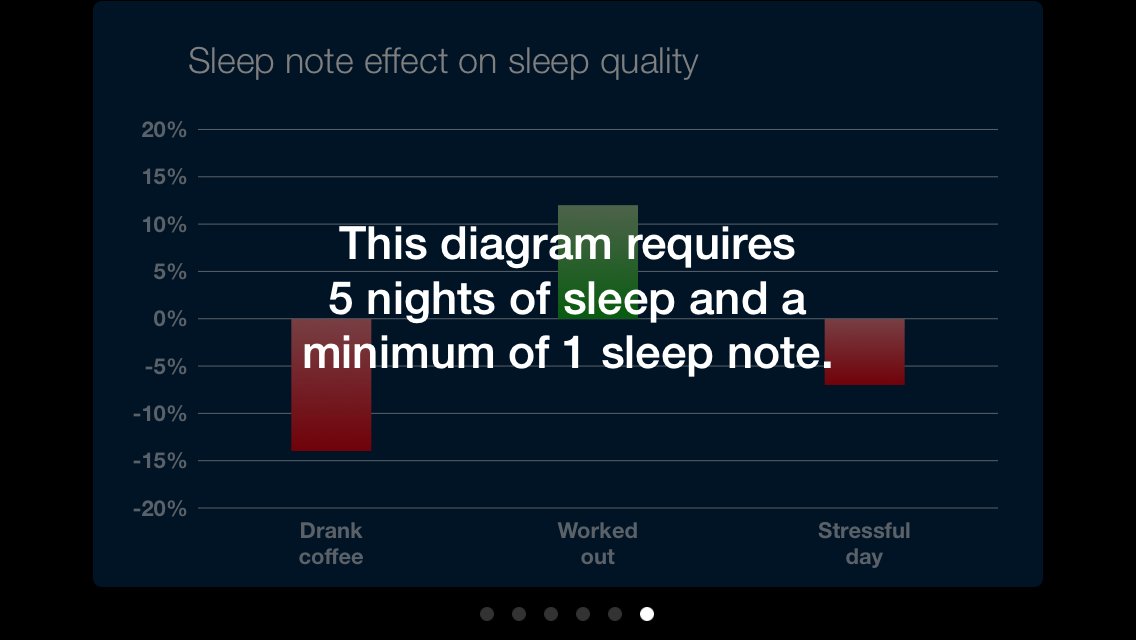
As you start to log more nights of sleep in consistently, you the app starts to give you graphs of the different statistics such as:

Time in Bed

Sleep Quality

Went to Bed

Time in Bed Per Day of the Week

Sleep Quality Per Day of the Week

Sleep Notes

The Alarm
The alarm feature is one feature that the app really emphasizes.  Because the app is able to monitor sleep patterns, it is able to determine what the best time to wake up for the person using the app.  Personally, I typically feel a lot better when the app wakes me up because it feels more of a natural wake up.  The only problem is that the alarm is a little too soft to hear for some people.  

The app wakes you up in between two times of half hour increments, whichever time is most natural based on your sleep patterns.


Sustainability:
Sleep cycle has been out for several years now, the copyright being 2010.  Since then it has been featured various times with publications and media outlets such as CNN, Wired, The Guardian, The Wall Street Journal, BBC, The New York Times.  It has a five star rating for the current version with 2,308 ratings and a four and half star rating for all version with 63,581 ratings.  From what I've seen that is pretty impressive.  I predict that the app will continue to receive updates (the last being January of this year) and get better.  It already has a pretty loyal following, the few people that I know who have used it only say positive things about it.

Usability:
The app is pretty straightforward.  It asks you what time you want to wake up (as shown above) and all you need to do is place it on the side of your bed (typically under your covers) near where you sleep.  You do have to leave the phone plugged in to the charger all night, but it's probably not anything we don't do anyway.  The only problem I ran into was trying to find how to use the "notes" feature, which allows you to keep track of what you did right before going to bed, or even what you had done that day that might be relevant to your sleep quality.

Value:
The app does cost $0.99 to buy and download, but it is well worth the small price.  The actual site mentions that similar alarm clocks that can monitor the body's natural sleep cycles cost about $200.  Personally, I think it was a good investment for what it does, and it's something that I use almost everyday.

A few drawbacks that have been mentioned is:
- You have to keep it plugged in all night, or it will drain you battery
- You do have to bring it into your room, meaning possible disturbance from calls and texts
- The accelerometer picks up movements of everything, including bed partners and pets
- Sometimes the alarm will wake you up earlier than you had wanted to because of the 30 minute increments
(I found these concerns here)

Conclusion:
I have enjoyed this app very much, although sometimes I forget to use it.  However, the app doesn't punish you for missing days.  Understanding my sleep patterns has been interesting and it has helped me be more aware of what I might be able to do to get better sleep.  Overall, I feel that it has been a very good investment for how much it costs and for what it has the ability to do.

Friday, February 7, 2014

Assessment 1

How public opinion may have been influenced through social media and new devices -
This is an interesting topic to consider because for a good space of time, this was a hot topic on social media. I would say the role that social media has played in this whole debate is pretty significant, at least in the eyes of the public.


Personally, the first I even heard of the whole issue was when I had logged on to Facebook, as has become the daily routine, to check and see if anything was new. I kept seeing graphics, posts, and pictures of different sides of the issue. Mind you, the majority of my contacts fall under a few categories - conservative Mormons, Filipinos, and the occasional friend with liberal views. Personally, the reality that was created for me based on my social media involvement has been that what has happened has been a somewhat negative step, given that most of what had been posted was not very positive regarding the issue. Not discriminatory, but a little worried.

Delving into the issue a little deeper, I found a Facebook page with a fair amount of traffic, that was definitely in favor of marriage equality in Utah. I imagine, if you had liked that, there would be a steady amount of pro-marriage equality posts streaming down your Facebook feed. However, aside from the very obvious pages created either for or against, I think what was most prevalent were the articles that were being re-posted by some friends. The articles detailed what was happening, and if anything sped up the process of information dissemination.

Based on what we had discussed, depending on which side of the fence a person happens to fall on, you gain a really narrow view of the subject. Obviously, most of the people you're friends with will share a lot of your ideological views, therefore what they post will only fuel the fire, strengthening views you probably already have. It really has created an even wider gap between the two prevalent ideologies. Furthermore, it seemed, according the articles and different posts that I saw on my feed, that although there is a lot of negativity regarding the issue, the loudest voices were those who were pro-marriage equality. Even the pictures used for articles were of LGBT members, picketing, smiling, or just being generally happy. Even if I was just scrolling my Facebook feed, and didn't care to read the articles, it made everything seem like a very positive thing. That contrasted with the different "worried" posts was an interesting contrast.

What you think about technological determinism's role in this -
I supposed it could be argued that technological determinism's role in this issue has been the quick dissemination of information, and the ability to frame ideas and event in a specific way. Hearkening back to what I had talked about earlier, similar to the way the feeling of an article can be somewhat framed by pictures that are used to accompany it, the sharing of information, for or against an issue, can very much frame the way we see an issue. Similarly, given that Facebook, Twitter, Instagram, and Vine are all things that people use on a daily basis, what is being posted on those feeds could very much become the reality of the situation for someone. It is shaping the way that people view the reality of a situation because, as Twitter and Facebook have become, constant streams of information are being received and processed.

How social media have contributed to the push for action, either in efforts to petition for or against marriage equality in Utah, and to organize for civil protest -
Pointing again back to what I had said earlier, Facebook pages like the one I shared earlier and this one have played an interesting role in contributing to the push for action. Actually, just logging on to the Equality Utah page I found this little graphic:


The ability for people to send invites to events, to share about upcoming events, to let others see where they can rally together for their cause has been pretty big. I really think some of the images that were used to depict what rallies looked like, with people being happy, and all the signs, has been huge in giving people the courage to come forward and join. Additionally it gives the appearance that there are many people supporting the cause, whether that's really the case or not.

In conclusion -
Social media has played a really big role in the whole issue, with first of all providing somewhat of a narrow view of one side. There is a social filter that has been created as a result of social media, something that doesn't exist in newspapers or even online articles. These filters can providing feeling and perceptions of an issue that may or may not represent it's reality. Furthermore, social media has allowed for quick dissemination of information, and as mentioned, the ability to frame the reality of an event. Above all, however, social media has also become a means of rallying people behind a cause and portraying the cause as powerful and effective.

Monday, February 3, 2014

Who is driving whom?

It's easy to look at how technology is seemingly driving (ha, I get the pun now with the cars... yeah) the development of our culture and society.  I spend a lot of time (a lot more than I should) on social media and I definitely have seen a particular culture arise from our increased connectivity and people's desire to share personal and significant events with many, many others (a majority whom they are not very close to).  To some extent this can be very disturbing, as referenced by all the post-apocalyptic movies that have been produced where technology has totally overrun humanity.  However, I'm not sure that is how things are going turn out.  Furthermore, I'm not entirely convinced that technology is the driving force behind the change in our culture.

Humans have this nagging tendency to want to believe that the way that things are going to turn out is completely out of our control.  We seem to want to pass on the ownership of actions, and ultimately our destiny to other things - misfortune, luck, karma - anything to be able to say, "you know, there wasn't really anything I could do about it."  It seems like a silly concept, given that we try to control so many factors in life, but for as long as our history has been recorded, humans have pointed to the sky and asserted that "there is something else at work here."  While I believe in a God and other doctrines pertaining to deity, I also believe that we have a lot more control over things than we think we have.  We are not objects to be acted upon, but agents to act (sound familiar?).

That being said, I can see similar patterns in technological determinism.  Where people assert that our culture has been shaped by the technology that we have adapted, it seems that just as likely, we have adapted technology to match changes that we, ourselves, have facilitated.  It is we who are in the driver's seat, and technology is there to make the ride a little (or in some cases, a lot) better.  I agree it has increased the rate of speed at which we can share ideas and produce goods and services, but I don't believe that it's the driving force behind cultural change.  We've shaped technology to meet our insatiable wants and needs.  Furthermore, it seems that technology has been developed to get us closer to what we think we want.  To make things easier and more convenient.

So, no, I don't really buy into the idea of technological determinism.  I think we should take both ownership and responsibility for the change we introduce and cultivate in our culture.  Technology will always be present, but first and probably forevermore it will be an extension and fulfillment of what we want as humans.